
Self-Compassion

I’ve been writing a lot about the importance of Self Esteem, but now I’d like to take a good look at something that is just as important to build on. Self-compassion is a hot topic right now within all aspects of society urging people to look after themselves, especially their bodies with healthy eating and exercise. But what about our minds and souls? How do we take care of these? Most of us find it fairly easy to show compassion for others; in fact, we can be pretty good at putting others first and caring for those we love. But what about ourselves?

Take a look at the checklist below. Try to write down the statements that apply to you just as they are written on the list.
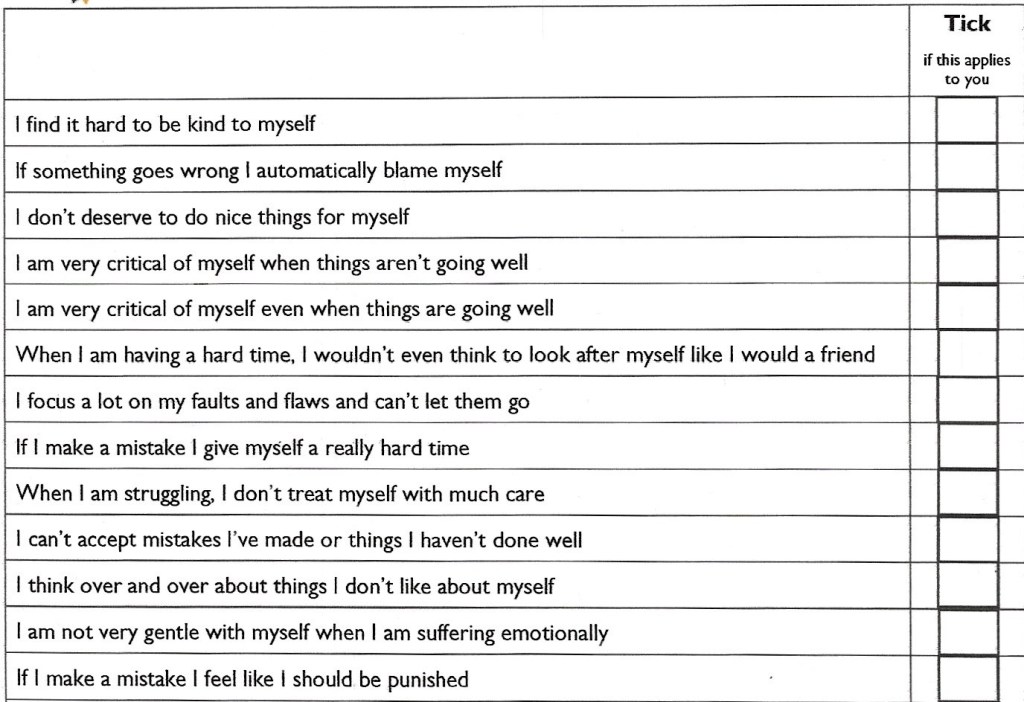
How many did you need to write down? If someone else was doing this exercise and had written down all the things you did, what would you say to them? If your inner child felt the same way you do, what would you say to him/her? Can you see how hard you are on yourself? Do you think that’s fair? If someone else was being hard on themselves, what would you say? Do you think other people deserve to do kind things for themselves? What would you say to a friend who was focusing on all their faults and flaws? How would you treat a young person who was suffering emotionally? What kinds of things do you think people should be punished for? Why do you think you are any different than all those “other” people? I think that is an extremely important question. I would have to ask myself, am I different? How am I different? Do I need to be better than everyone else? Well, you might say yes, but that would be a core belief. One that needs to be challenged. You can get some ideas on how to change core beliefs from my post on Self-Esteem Part 3. Remember that if you find yourself really struggling with this that help is out there, you just need to ask.

Being kind to ourselves can sometimes be difficult. The harder it is for you, the more you will suffer–emotionally. If statements like…I don’t deserve kindness…come up for you, maybe you need to ask for help from a therapist or social worker. I definitely needed help to see that I deserved kindness, that I deserved happiness. I felt guilty about happiness, actually, and sometimes still do! It can be difficult to believe these things, but we have to try for our own well-being. To bring ourselves out of a depressed state, it’s important to be kind–to ourselves.
Self Esteem Part 3

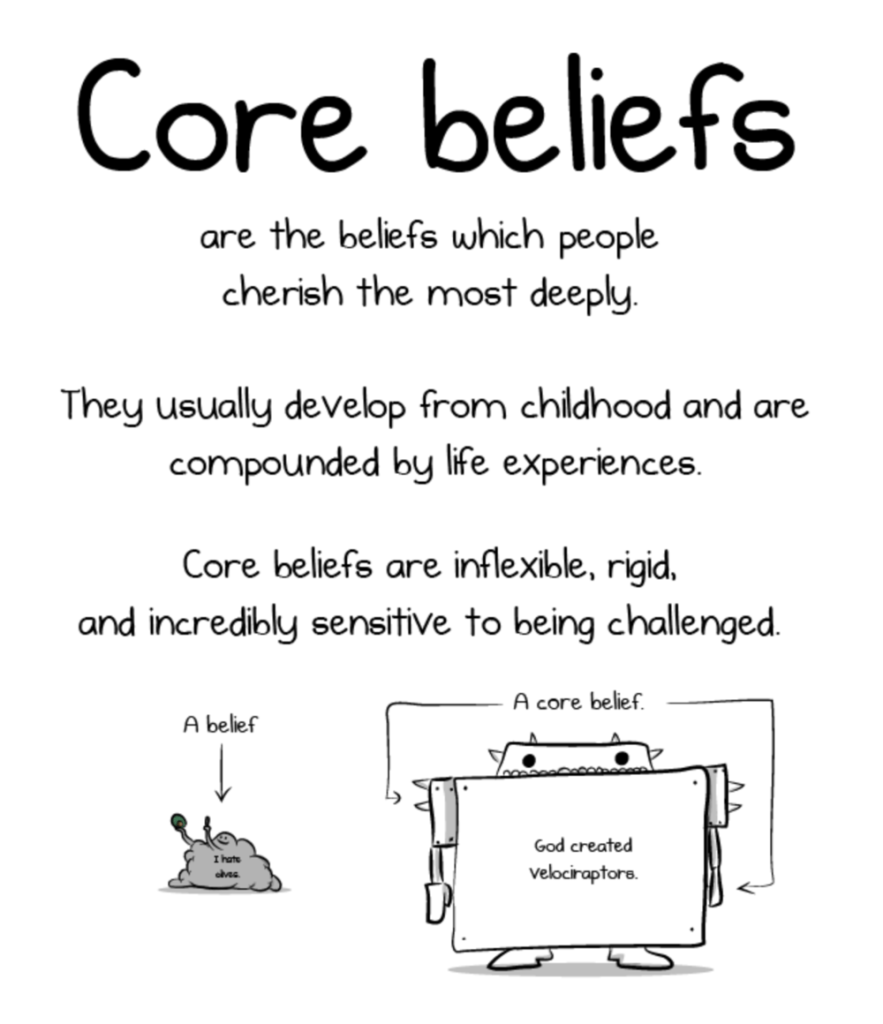
Today I want to talk about Core Beliefs. These are deep seated beliefs that were formed when we were very young or through adolescence. I believe we all have these opinions of ourselves and that they can be both positive and negative. A belief in and of itself is defined as “any cognitive content held as true”. As shown in the picture above, a general belief is malleable; it can be shaped and re-shaped. A CORE belief, however, is sturdy and it is difficult to change its form. This phenomenon or remarkable development is the driving force behind our psyche, I believe. And it can either save or ruin us. Another definition of belief is that it is an “impression, feeling, notion, opinion a vague idea in which some confidence is placed”. So, a belief is an opinion that is held as true. If it is just an opinion, it can be changed. Even though it is stringent and carved deep into our minds, it can be changed. And THAT is a very important aspect of our negative core beliefs.

Hopefully not all the beliefs in the diagram above relate to you, but I am sure that everyone can find some. Read them over and write down the ones that you can relate to in a notebook or somewhere you will be able to find them because we are going to challenge these core beliefs one by one. Doing as much as we can on any given day or in any given moment as might be the case. I’m going to begin with some of my core beliefs that come under Defectiveness.

  • I am a failure
  • I am unattractive
  • There’s something wrong with me
  • I am a bad person

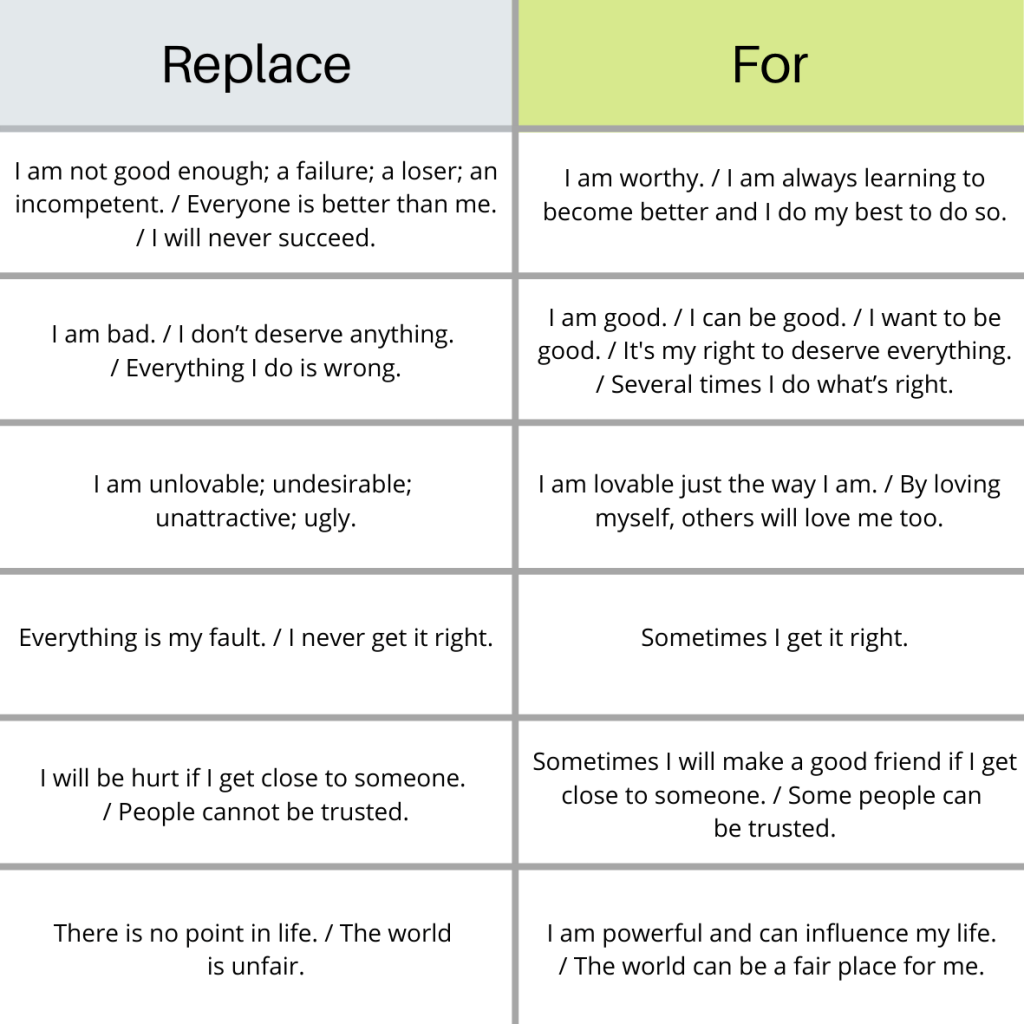
Now I’m going to put these beliefs into a chart form, very much like this:

I want you to notice that the replacement statements are not all or nothing. Words like sometimes, can be, some, several etc. are used in order to make the new beliefs more believable to myself and others. Try and make up a chart for yourself, changing your negative core beliefs into more accurate opinions of yourself. Opinions that are likely closer to the truth than the negative thoughts you usually place on yourself. I don’t think this is an easy exercise, but it is worth trying and worth writing down. Get rid of those nasty self critical statements and build yourself up for a change. You deserve to be happy. You deserve to be recognized. You can and will be successful!

Self-Esteem Part 2

In my last post, we looked at what self esteem is and how it can effect relationships. I left you with an exercise to try. I wonder how many of you actually did it or at least tried? Some of us would find that exercise very difficult and maybe even impossible right now. That’s okay. No worries. This is not a test! It is an information piece with some ideas for improving self esteem. In this post, I want to take a deeper dive into low self esteem and how it might show up in our lives. The diagram above is an excellent visual of what low self esteem looks like. Try to think about each of the sections honestly. How is self esteem affecting your life? Do you need to do some work on it? I know I still apologize a lot, but I’m seeing improvement in this area. Asserting myself, at times, is difficult. I just don’t seem to have the energy I need to maintain assertiveness for long periods of time. Given a lengthy situation, I will often give in to other people. I can definitely see myself improving in this area. I’m still struggling with being perfect; although, I am more apt to laugh at myself more often now than I used to. Negative self talk–putting myself down–comes, but leaves much quicker than it once did. At one time, I felt I had to please everyone. You can imagine how difficult that would be with so many different perceptions of things in this world, it is dam near impossible to please everyone, but boy did I try–no wonder I failed. But I didn’t look at it that way. I was a failure–period! It seemed I also failed at perfection. I don’t know why I thought that I had to be better than everyone else but I did. I tried–again and again–I still tried. I won awards at my two major workplaces and I wondered why? How? I thought things like: I don’t deserve this; how did this come about; there couldn’t have been any others who were nominated; etc.. I had two major breakdowns in my life because I won awards that I didn’t think I deserved. I am bad. People don’t really know me. How am I pulling the wool over everybody’s eyes? Maybe you’ve been there. Maybe you know what I’m talking about. I know, now, I wasn’t alone with these thoughts. I’ve met others who have struggled as well. And you’ve now met me! I’m okay really. LOL. And so are you, because you’re reading this and you’re going to get yourself some help and follow some of the worksheets that I’m going to put a link to. We will both be okay. We are okay now! Let’s work from there.

Here is the link to a Self Esteem Workbook. If you can, do the exercises! If you’re struggling, try and do a little bit each day. Set an alarm for 5 minutes, even, and if you still want to go on after that, keep going! Then try for 10 minutes or even 6. Baby steps at least move you forward. You can DO this! But it’s okay if you are struggling to manage even a little bit. The time will come. Maybe, right now, you could go to the site and bookmark it. That’s the first thing I did.

https://www.cci.health.wa.gov.au/Resources/Looking-After-Yourself/Self-Esteem

Try and follow the Modules in order as there are important exercises in each one and they are meant to be done sequentially. Kudo’s to you for getting this far!

Self-Esteem Part 1

There are several facets to self-esteem. There is low, high and inflated self-esteem. As you might guess the esteem we most want to realize is high self-esteem. This allows us to speak freely about our thoughts and feelings while respecting the rights of others as well. If we have high self worth, we don’t worry too much about what other people will think of us. As you likely know, with low self-esteem, we are always worried about this. We live our lives in fear most of the time because we want people to ‘like‘ us. But this type of thinking can get in the way of building healthy relationships as we are always bending over backwards to please others. This is a difficult position to be in because often the sacrifices to our own well-being are threatened which can eventually lead to anger towards others. How does this work? Well, we give and give and give, often without much in return, but the other person doesn’t know how we are feeling because we’re too afraid to tell them. This can build up resentment towards others which often results in us ‘blowing our tops‘. If this type of anger is what you experience, then you may suffer from low self-esteem.

Of course there are other things that could cause us to become unhinged. Possibly we’ve just had enough of other people and the decisions they make. Or maybe we’ve been keeping something inside for a long time and eventually we just blow. Becoming angry because we’ve allowed others to walk all over us is a sign of low self-esteem. Familiar thoughts would be: I’ve always been nice to him, how can he do this to me; I’ve been doing her laundry for weeks now and have never had any thanks. The truth is that once we start ‘doing‘ for others, they begin to expect it. We’re all nicey nice and say we don’t mind, but eventually it gets us down; especially if the other person begins to expect even more from us or criticizes what we’ve done–because people with low self-esteem really can’t handle criticism. I mean, we spend most of our time being self-critical so when someone else criticizes us, we can break down and feel even smaller than we already do. I really wish I could handle criticism–and I can, sometimes–because I want constructive criticism in order to become a better writer, thinker and speaker. Constructive criticism is a really healthy part of our lives and learning to handle it is extremely difficult when we suffer from low self-esteem.

Because ‘being walked all over‘ is unhealthy for our own well-being and for building positive relationships, trying to build our self worth is an important process on the road to healthy emotional being. “Whether you think you can, or whether you think you can’t, you’re right“. We’ve talked a lot about the connection between our thoughts, behaviours and feelings and it comes into play again here. Building high self-esteem stems from changing our thoughts. I remember being very unsettled about this process. Telling myself things I don’t really believe just didn’t sit well with me, but I persevered and continued to work on my negative self-talk. One exercise, I remember well, is to think of positive affirmations that begin with each letter of the alphabet. My list went like this: I can be amazing, I am boisterous, I can be confident (you notice I have put in words like ‘can be‘ instead of ‘am‘ because it is more believable for me), I am dedicated, I can be efficient, etc.. Try this exercise if you struggle with low self esteem. Remember that to get what you’ve never had, you must do what you’ve never done. Eventually, you can progress to more ‘ams‘. I have these statements hanging on my wall at home and I read them often. What actually happens is that we begin to believe these positive affirmations. They become part of our vocabulary and fill our thoughts. Having these thoughts in our heads results in belief of them which changes our behaviours and our feelings as we begin to stand up for ourselves and speak our minds which allows us to begin to feel more positive about ourselves. Give yourself a chance to become the person you are without the self-criticism. You CAN do it!

Check out these CCI resources to help you follow the steps you can take. It is also best if you have someone helping you like a therapist or social worker as it gives you someone to share your progress and journey with. It is easy to become discouraged and difficult to persevere on your own, but you CAN do it!

https://www.cci.health.wa.gov.au/Resources/Looking-After-Yourself/Self-Esteem

Use your own creativity or this example to come up with your own positive affirmation list. Then display it somewhere you can see it often! Try saying them out loud until you actually believe them.

Prelude to Self Esteem

I just want you to know that I worked and continue to work through my mental health struggles with several mental health professionals. I do not do it alone! There are exercises and books I read on my own, but I always have help if I need it. Working through some of the exercises can be triggering and can bring up unwanted feelings of self-doubt. Sometimes these feelings can be debilitating and I get knocked down pretty hard. Please remember that help is out there and reach out! Nobody expects that you do this alone, in fact, I strongly urge you not to. I’m not talking about sprinkling a little bit of sugar over feelings so they will go away; I’m talking about deep down heavy work; it can disrupt your life and you need someone to share with.

As I begin to talk about self-esteem, I just want to make sure you are getting the help you need with this often threatening subject. You may be tempted to blow off this warning but I certainly don’t support that. This is a guide. My journey has been long and hard and I continue to struggle at times. I need my support network. I have friends whom I share with, I have a therapist, a social worker and a psychiatrist. Over the years, I have been hospitalized, medicated and have worked through some grueling in-patient programs. I’m not saying you will need to do all this, but you might, and I want you to be supported all the way through. Remember, we are talking about your life here and if you are thinking of changing it, please do so with a good support network.

Self Stigma and Shame

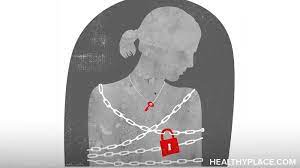
Self stigma occurs when we lock up our feelings and thoughts about ourselves so nobody else can perceive them because we are afraid of what people will think. We believe our feelings are shameful and therefore we walk within a dark shadow on a circular road that never ends. We isolate, avoid eye contact, shut down, harm ourselves–both mentally and physically, we try to avoid the situations that would most benefit us and we go around in circles trying to climb out of this hell we find ourselves in, but to no avail because we won’t allow anyone else in. We sacrifice a life that could be full of possibility in order to avoid the shame we feel inside. It’s a vicious circle and can only stop when we say it stops. The saying, “In order to get what you’ve never had, you must be willing to do something you’ve never done” comes into play here. We have talked about the feelings/behaviour/thoughts triangle and this is where it can be extremely useful. Somehow we have to step out of the circle. We need to change the route. We need to attempt something different than what we’ve been doing. So, if we avoid eye contact, we need to try and make it. If we self harm, we need to put soothing cream all over our body. If we isolate, we have to call a friend and talk about the weather or a familiar, neutral topic. Maybe we finally ask for help and call a crisis line.

What we can’t do is stay on the same path; it is an endless circle, a dark, lonely infinity trail. The longer we stay there, the worse the darkness becomes and the harder it is to claw our way out. I’ve been there. A place where the shame is so debilitating I really wished I would die but I continue to pour it onto myself. The heaviness of it wears me down. Getting out of bed is nearly impossible. And if I do make it out, I park myself on the couch and stare blankly at the four walls as they close in on me. My mind is inundated with dark and scary thoughts like: I’ll never be good enough; I’ll never amount to anything; nobody will miss me; I’m a burden nobody wants; I’m a failure; I’m stupid; I’m pathetic. You know why I believe all of these thoughts? Because other people suffer too, but they can get out of it; they are able to right themselves; somehow they can find the strength to go on, why can’t I? What’s happened here is that I’ve shamed myself to death! I’ve compared myself to others who are not on the same path I am on. I’m mentally ill or in better words, I have a mental disorder. It is a medical disease. I am not my illness! You are not yours! These debilitating thought patterns are a symptom of the disease. They are like a crack in an x-ray that needs to be fixed. They are like high blood pressure or heart disease, diabetes or even cancer. Yes, Mental Illness can be as debilitating as cancer. It takes lives; it destroys lives; but, it also responds to treatment, like disease. Medication and Therapy can help, once the right cocktail is served up. It is up to us to take that first step towards recovery. That first giant leap. As it is also up to others who struggle with disease to go to the doctor, get checked out, research online. We need to do it without fear of what others will think and that is possibly the hardest part of living with this illness. The self-stigma causes us shame and we can go untreated and unheard. Let’s make a difference in our own lives and stand strong against this stigma. You are worth it. You can shine. You are special–just like everyone else!

Why all the Stigma?

What is stigma? “A mark of disgrace associated with a particular circumstance, quality, or person” according to Oxford Languages. Why is there stigma around Mental Illness? We only need to think about that for a little while and we’re faced with representations of “crazy” from movies and the past (insane asylums). But, why is it still here? I mean we live in a new age now. Mental health is at the forefront of almost every profession. We teach it in our schools through a Growth Mindset. Bell “Let’s Talk” and other businesses sell it to the mainstream public. Why hasn’t it reached the actual psychoses of mental illness? Why are people still afraid to admit they are struggling and seek help? Why are those who do seek help afraid to tell anybody? Why do those of us who have been struggling for years still want to hide behind lies because we are afraid of being “found out”?

Maybe it’s insecurities that are indicative of our diagnoses. Perhaps it is our own judgment of ourselves. Possibly we’ve just lived with it for so long that we fear there is truly something wrong with us, as people. The real question I have, is whether stigma lies solely in the truths we build around ourselves or is it actually “out there”? In other words, is the stigma we experience now, just in the minds of those of us who suffer from mental health issues or does the general populace actually exhibit it?

I can’t answer these questions for myself so I certainly can’t proclaim to answer them for anyone else. But there are a few things I can pass along to those who struggle with their mental health. First of all, if you haven’t sought help, do it now! Make it your first priority—today! Don’t put it off until it’s too late. There is help out there, you only need to ask. Don’t know where to start? Local hospitals, crisis lines, local CMHA, ask a friend, talk to your doctor, ask a teacher, your union rep, maybe even your boss or a colleague if you feel comfortable, but seek help. It is the first step in your journey. A journey that will be filled with ups and downs, trials and errors and success and failures. It will replicate life but it will help you to conquer it, to break out of your bubble and to become yourself. Living with mental illness is chaos and stability; all the dichotomies of life will come into play but it is learning how to live with these dualities that sets you free. Give it a try, please. Because we need more people like you not less and our fulfillment of life will be better with you in it. Don’t wait. You are special. You have something to share. You are one of a kind. Seek professional help and become a part of something bigger than yourself but of yourself.

Mindfulness

Mindfulness has become a mainstream intention over the last couple of years and is used in all kinds of general adaptations that bring people a full life. It is also used in Mental Health. What is mindfulness? In my own words, mindfulness is being present in the moment, observing our thoughts, feelings and actions without judgement and accepting what is happening without changing anything. As you can imagine, if you have read my last two posts on “Accepting your Feelings” and “Changing your Feelings”, mindfulness plays right between the two. In other words, mindfulness is needed in order to both accept and change emotions. You might be wondering how mindfulness works if it is not to change anything. The key is that when we are being mindful, although, we are not trying to change anything, we are accepting and acknowledging the things going on around us without judgement. The strangest thing is that through doing this our thoughts, feelings and behaviours just naturally change. We arrive at a space where we are no longer absorbed by distressing thoughts and in turn our emotions change. Practicing mindfulness over and over–especially when we are doing well–helps us naturally drift into this space when we are distressed.

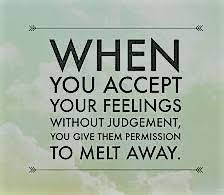
Accepting your feelings without judgement allows you take a step back and just be in the moment. Observing the emotion without actually being connected to it–as if it is a movie on a screen. Once in this special space, we can begin to be curious about its presence. What is it doing here? Why has it come? Is there a reason for its existence? All the while being non-judgmental. This feeling is okay; I just wonder why it’s here? Curiosity is very different to judgement. We are not labeling the emotion as good or bad; we are simply questioning its existence. I will share an example from a recent experience of mine involving anxiety, which is really the fear that something bad is going to happen. I was just walking my dog and all of a sudden, I was shaking inside and out; my heart was racing and my breathes were shortened or held. I couldn’t stop walking without drawing attention to myself–as there were other people around–so I took a deep breath (my go to for grounding myself) and began to watch the anxiety as it seemed to overtake my body. I felt my heart palpitations and just focused on that without judging whether they were right or wrong, just recognizing they were there. I thought to myself, this emotion is okay. I’m allowed to have this feeling. The anxiety continued and I realized I was beginning to judge it as being unuseful in this situation so I went back to my breath again, stepped back and began to allow myself to feel the shakiness and the fear–non-judgmentally. I kept walking, the feeling was still with me and I started to look at it more curiously. Why am I feeling afraid? Is there a reason? Was I thinking of something else? And I’d come back to my breath again. Refocusing. Gradually, the anxiety began to fade a bit–not a lot, but enough to give me some reprieve. All this time, I am still walking and still aware of how the muscles in my legs have tightened and I feel as if I’m walking stiffly; I tell myself, that it’s okay. This is how fear manifests itself. As you can see, it is not an easy task and I have been practicing for quite some time and it takes time–a lot of practice and a lot of time, but it can be done. The anxiety receded somewhat and by accepting its existence as a part of my life, I was able to finish my walk without the escalation to panic as sometimes happens. Breathing is important during this time–being aware of your breath. In this case, the feeling did not change much but at least it didn’t progress further. Anxiety and Panic can be fierce and intense. They can cause us immense distress. Being able to see them for what they are–just feelings of fear–removes some of the power they have over us. This is true for any feeling. They are just feelings; sometimes not even realistic ones–but that’s a judgment!

Changing Your Feelings

I’ve done a lot of work with Cognitive Behaviour Therapy (CBT) and Dialectical Behaviour Therapy (DBT). There is no easy way through this type of therapy; it is just plain hard work! I’m not saying other types of therapy aren’t hard work, they are; I just want to acknowledge to myself and to you how much mental effort it takes to comprehend and put into practice this type of therapy. In actual fact, acknowledging my own hard work is something new to me; I don’t know about you, but I find it very difficult to accept my own accomplishments so stating that here is BIG for me, personally. Deep breath…

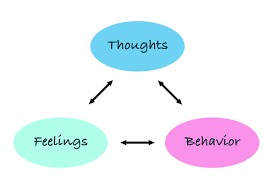
Yesterday’s blog (Accepting your Feelings) resulted from some of the effort I’ve put into understanding DBT. No easy feat. I’ve gone through it three times so far and I’m sure there is still more I can learn. In this post, I want to talk more about the main message from CBT, that is, that our thoughts, feelings and behaviours are all connected. How does this work? What comes first? Well, the truth is that any one of the three can affect the other two. For example, when I get depressed, there are certain thoughts and behaviours that coincide with that depression. I would usually isolate, avoid eye contact, walk slowly, hunch over and stay in bed. I would also be thinking about how my life sucks, how I can’t do anything right, that I’m a failure and that I’d be better off dead! I have suicidal thoughts, yes–often. Deep breath…. This is where the principle of CBT comes into play. The reasoning is that if our feelings can affect our thoughts and behaviours that if we change one of these two, it will also change our feelings. Believe it or not, it works!

Although changing our thoughts and behaviours is a difficult task at times, it is encouraging to know that what we think and do can alter our feelings. What this means for us is that we don’t have to be controlled by our emotions, but that we can control them! It’s such a freeing thought, isn’t it? The really cool thing is that if we maintain healthy thoughts and behaviours that we can generally maintain a healthy mood! That’s where I’m at right now. It doesn’t mean I won’t fall back into depression again. It just means that, for now, I can focus on wiser behaviours and thoughts. It’s called Wise Mind in DBT. This is actually the reason I started this blog. I have always written things down, often in poetic form but also with fiction and keeping up a journal. I am also very interested in advocating for mental illness and the possibility of helping others who struggle with this debilitating disease. So, here I am and this is the result of acting (writing a blog) upon a healthy thought (wanting to help others) and how it has changed my feelings as I am now more satisfied with my life.

Accepting Your Feelings

I believe that one of the best ways to change your feelings is to first accept them. It is a true gift to be able to accept this dichotomy. It takes a lot of hard work, focus and non-judgmental thinking practice to really accept my negative feelings. Fear, Rage and Sadness can be overwhelming and seem impossible to accept but this is the beginning of wisdom over your feelings. So, how do I do this? I hate this rage! The anxiety is debilitating! The sadness envelopes me and drowns me! There is no way out of this! I have felt this way before and it’s never going to go away! Without mentioning all the cognitive distortions in these statements, I have to tell you that they can go away! Probably not forever; maybe for only a moment; but, they can go away. Feelings, after all, are changing all the time. They come and go, just like the clouds on a sunny day or the waves as they ebb and flow. The reality is that feelings are with you for a reason; there is nothing wrong with having feelings; and feelings return and fade just like the sun and the moon. They are there all the time, we just don’t always see them. When I experience negative feelings that become overwhelming, I find it’s best to take a step out of them. Out of myself. I really try and imagine watching myself having those feelings just like I might watch a movie on a screen! I stand back and breathe. I try not to become enveloped by my emotions; I just watch–non-judgmentally.

To be non-judgmental, I can’t put any value on what I am experiencing. I can’t label it good or bad. It just is! Feelings just are! I have to practice and re-practice this mindful experience without calling myself names or telling myself I am stupid or a failure. I just watch as they play themselves out in front of me, as they perform their little dance, just watch and breathe. One nice thing about our breath, is that it is with us all the time; it is not a card that we have to look for. It is just there, always! At this point, and quite honestly, it doesn’t always work quickly–nonjudgmental–I am becoming present with my feelings. I am sitting with them, experiencing them and allowing them into my life and you know what? These feelings are okay!

For more information on how to accept your feelings, you can visit the CCI site that is pinned to the bottom of my logo. When you click on that, you can scroll down to “Tolerating Distress”. Here you will find a workbook on “Facing Your Feelings”. You might find some of the information repetitive, but I found doing the exercises and writing out a “script” for Mindfulness Distress was extremely helpful in understanding how to “sit” with your feelings.

https://www.cci.health.wa.gov.au/Resources/Looking-After-Yourself