Emotional Laundry: the Truth Beneath the Grime

No one teaches us how to feel. Not the real way. We’re spit out into the world like emotional little androids—screaming, blinking, “Hello, world?”—and expected to function. Expected to swallow grief like vitamins and stack trauma like it’s laundry.

And it is always laundry day.

b8f21a22-9a18-4c9c-8f25-bad14c1e533f-1

Emotions don’t go away. They wait. Like socks in the corner—anger stiff with old sweat, shame curled in the toe of regret. Grief? It’s that shirt you can’t throw out but can’t wear anymore either. You don’t know how long it’s been there, but it reeks. And when you try to pretend it doesn’t exist? It comes alive, slaps you with its sleeve and screams, “Wake up. Wake up.” But do we listen? 

So truth doesn’t whisper to us anymore. It ambushes. If you ignore it long enough, it doesn’t fade—it sharpens. It gets cocky. It goes full “I told you so” while you’re still crawling through the aftermath of your own silence.
b5adc928-5207-4798-bd54-e7f548b824b5-1

So now I sit with my emotional mess like a weirdly tender laundromat priestess. I don’t sort it to fix it. I sort it to know it. Darks over here. Joy over there. Guilt? Still damp. Grief’s turned inside out again. Rage has holes in it but still fits like it was made for me.

And no—I don’t bleach anything. I honor the stains, the scars—that’s where my story lives; where your story likely lives—because emotion needs to be heard, not silenced.

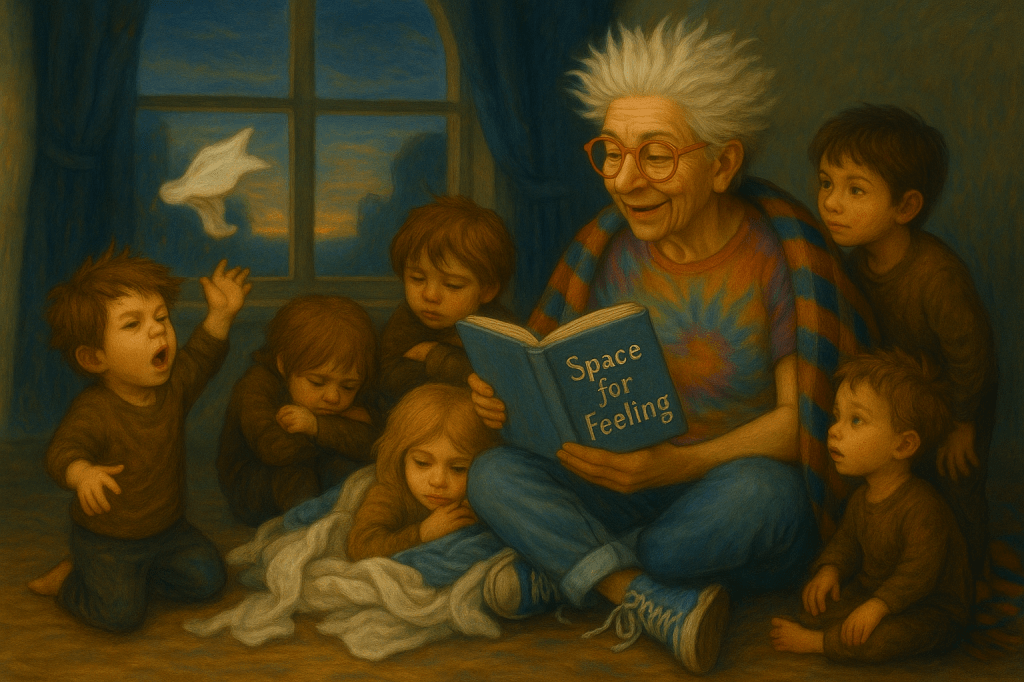
I gather all of them around—my misfit feelings, the whole neglected crew—and we sit in a circle. I light a peace pipe. It’s awkward. No one makes eye contact at first. But then shame cracks a joke. And grief laughs like it hasn’t in years. Even anger unclenches a little.

And for a moment, it’s not chaos. It’s communion. And I laugh too—because I realize I’ve spent most of my life thinking I was lost. But I was never lost. I was spit out—unclaimed. Launched into a world that doesn’t know how to feel and punishes people who try. I flicker between heartbreak and celebration daily. You probably do too.

c8ac33bf-0875-4154-bba1-d04a3d021473-1

So I sit. I listen. I let the parts of me that smell bad and shout too loud stay awhile. Because I’m done exiling myself in pieces, and I’m not here to transcend emotion…I’m here to be a home for it.

Not perfect. Not pure. Just present.

I stink and I’m sacred (and scared).  I’m heavy and hungry. Fractured and whole. This is not a flaw in the design. This is the design. Me. You. As we are—complete—with all our messy feelings that get in the way and everything else—that’s who we are—that’s what we need to celebrate.

Can we do that? Celebrate messy, confused, scared and lost? That’s the fanfare! That’s the juice of life. 

63627976-5cb6-401c-b6d8-defcb5dab502-1

Let’s make it all sacred—the lives, the deaths, everything we are about. Let’s share the heartaches AND the joy and appreciate all of it. Because the heartache teaches us how to be present in joy. And the joy teaches us how to be present in heartache. We can feel both and survive. 

Let’s return to ourselves, now, here, together. Embrace our humanity because that’s who we are. 

Do you have the courage it takes to meet and be yourself? Do I? Well, “I Choose Me” is my new mantra—it’s not selfishness, it’s soul-alignment, and I believe we all need that—just like any old washing machine.

d9403dd3-a893-4b81-911a-941787f87581-1

So, here it is. My emotional laundry—wrung out, line-dried, still a little wrinkled. Not for applause. Not for pity. But because the world’s gotten used to seeing masks like they’re clean clothes. And I’d rather show you my stains than keep pretending I’m fine.

If anything I’ve laid bare here made you flinch, pause, nod, or feel something you haven’t in a while—good. That’s the thread. Pull it. Follow it.

Ask yourself what you’ve shoved in the corner. What still smells like fear. What’s been waiting for a wash, a name, a witness.

Because maybe—just maybe—the revolution we need isn’t louder noise. Maybe it’s brave, messy humans airing their truth in public and asking others, softly but clearly–you got anything to hang out too?

Whisper, “I do” and hit share.

Because we all have a corner full of socks and a soul that still wants to feel. 
peace balance empathy 

Executive Orders

From now on, I leave politics to the experts. I am a mere voter and lay person when it comes to politics. I should stay out of it. Learn what I need to and move on. Yeah. Need to get out of it now and back to my own agenda. For 3 weeks, it took grasp and pulled me down but here I am on the other side, triumphant again! Oh yeah. We’ll just see how long it lasts. Can I stay out of the news and focus on me again? Or will I get sucked in? 

Everyone is focused on Trump and America right now. What will he do next? They whisper—sometimes to themselves, sometimes to people they know really well, but most of them whisper. The ones who speak loudly and the ones who are heard are usually tooting a horn they don’t know everything about and instead of trying to understand each other, we hate. The poor did this…the rich did this…who cares who did it…let’s look at WHY they did it! Obviously, people felt something needed to be done, needed to be changed; Americans and Canadians alike are frustrated with the governments they’ve had for years; they want something different! Enter Trump! The perfect caricature for the job! An actor! A Billionaire! A Self-touting Egomaniac with a plan to make America Great! Again!

Trump has been called a ‘Saviour’ and a ‘Nazi’…loved by some…hated by others. I’m not sure there is anyone who doesn’t feel strongly about Trump in one way or another. He’s not really the type of person you ignore. I’m not sure he’s the type of person you SHOULD ignore. I’m not sorry I ventured down the Trump rabbit hole. I learned a lot  and believe that whether this man is your friend or your enemy, following him closely is advantageous. He lives on the edge and moves quickly. I, for one, will be keeping an eye open, but, for now, I need to focus on ME!

That means, coming back to my Self. Who I am. What I’m about. My values, my truths, my perceptions of where I am in the world. As long as I’m focused outside of myself, my Soul suffers. This was a good lesson. It’s time to come back to ME! That’s what I can control; that’s who I can  change. I made up an Executive Order for my Self:

I will cultivate value, worth, respect, accountability and reflection into my life and apply it by integrating courage, compassion, curiosity and connection into my thoughts, feelings and behaviours towards myself and others. 

These are the filters through which I will make decisions, determine my boundaries and find my truth.

This is where MY power comes from—the one thing I can control

peace balance empathy

Relationships and Growth-Inspired Communication

I am trying to communicate something in these posts by speaking my truths. I believe my truth is important because it meshes with other’s truths when I get down and dirty and communicate one on one. Why doesn’t everyone communicate this way? Share ideas about important topics? Most importantly, why don’t we communicate our needs? Think about when you were young…how did you go about getting your needs met? As an infant, we only know how to scream and cry and others have to figure out what is wrong with us. We check diapers, feeding time, warmth, illness…what is wrong with our little one? How many of us continue this lack of clear communication into our adult years, “Others should know what I need. I shouldn’t have to tell them!” We can actually place the concept of love into our arguments…”if they can’t figure out what I need, they don’t really love me!” we scream. We continue our childlike communication skills long after we have learned to actually speak and listen. Why don’t we use what we’ve learned?

Do we truly believe that others can read our minds? No, but we do have an abundance of expectation that people close to us should be able to figure shit out. Look at us, we haven’t grown up at all–we still expect that our needs will be met through guesses. Is it any wonder that we aren’t satisfied, that we struggle to be happy? I’ll even go as far as to question, do WE know what we need? Is that why we suck at communication? Because we don’t know, ourselves, what we truly need? Why don’t we know? Because we don’t know ourselves? I’m not sure, but it’s an interesting concept, don’t you think? When we begin to experience our true selves, we also begin to learn about what we need? Once I figure out what makes me tick, I can share my needs with others. Is this a bad thing? Is it selfish to express our needs? I’d argue that it’s selfish to have the expectation that others guess correctly what our needs are, when we’re not even sure ourselves! And, if it’s not safe to express our needs–as maybe it wasn’t when we were young–then we are not in the right relationship. If we don’t try, though, to communicate with our loved ones, it is on us, not them. It is my problem. My hang-up. I have no one to blame but myself.

One really cool thing about it coming down to me? I have the power to change myself–something I can’t do to others. I can’t force others to communicate, but I can learn to communicate, myself. If I start, will others? What if, even if I don’t know what I need, I express this…”I don’t know what I need, but it’s not this!” Because we can usually express what we don’t need. And, what if, after I’ve communicated what I need or don’t need, that I ask the other person what they need? And listen, really listen! That might mean asking questions to clarify. Get curious. If getting curious about the other person causes distress, I guess we need to figure out if that relationship is worth our effort? And sometimes it really will be, because what we get from it is satisfying us for the most part, but if it’s not worth it? If we’re giving more than we’re receiving–even after communication? Well, only we can decide. But staying in a non-communicative relationship is a choice and we can’t really complain if we’ve chosen it.

First things first, we need to communicate our needs, even if it’s what we don’t need. And we need to listen to the needs of the other person. Maybe, we can’t always satisfy those desires, but we need to understand what they are and decide, for ourselves, how to proceed. It’s kind of interesting, to me, that even if I can’t get the need met, communicating what I want helps me to accept the fact that it may not be satisfied. That, after recognition of my longing, I don’t actually need it fulfilled to the capacity I first expected. That I’m okay with a partial fulfillment because I recognize that only I can satisfy myself. That, that inner spirit, my true SELF, is the only entity that can truly satisfy me. Because, sometimes, that is the truth. The onus, though, is on us! Don’t vent about who’s going to be first; that’s five year old behaviour; we are adults. Why not act our age? Step up and out! Show up! 

If expressing our wishes and then reciprocating with a good listen puts us on high alert? We need to question the relationship. Just don’t forget to listen to the other person; maybe, even, if they don’t listen to you–at first. Why not give them the opportunity to express themselves? I’m interested in your war stories on this…how does sharing your needs with those you are in relationship with, work for you?

peace balance empathy

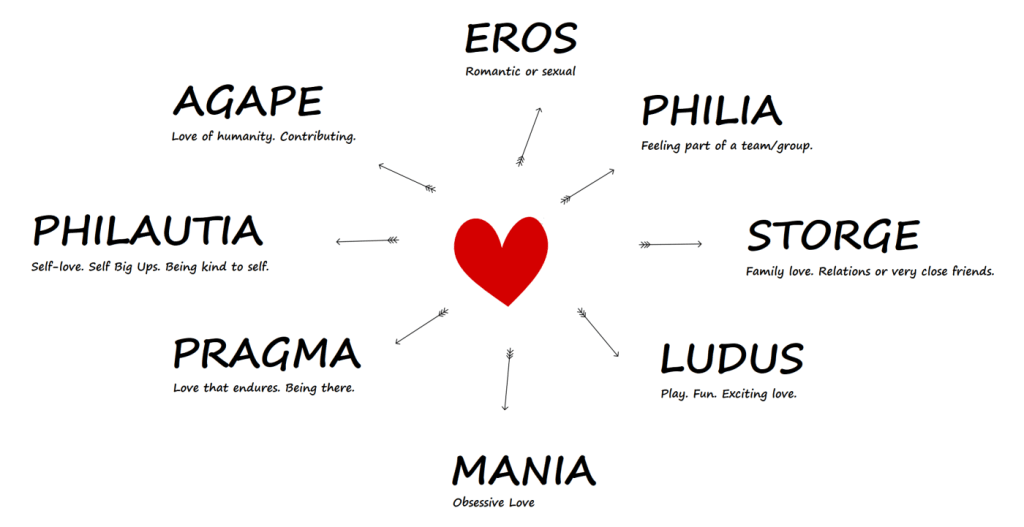
Love: Understanding What You’re Giving and Expecting to Receive.

https://authorjoannereed.net/different-types-of-love/

Let’s go back to the beginning of our lives again…to birth. The love we receive will have an influence over the love we learn to give, don’t you think? We aren’t born with an innate desire to love; we learn from what we receive in our early years. How was love modeled for us when we were young? How is it modeled these days? Where do we see love? How do we respond to being loved? What does love feel like? On social media, we talk about being kind to one another–a lot! Is this a form of love?  I believe If I asked 10 people what love meant to them that I would receive at least 5 different responses, if not more. Why is this even important? Well, are we all looking for the same thing? Expecting the same thing? Maybe I should put out a survey.

So…I asked the question…What does Love mean to you? I received an answer from two brave souls. Why so few? Are people afraid of answering for some reason? Or, are they unsure? Maybe, unlike my other posts, this one did not get recognition? So…what is love? I researched a bit and found several different types of love. Many of these are found in the Bible, but even if you are a non-believer, I think you would agree that love comes in different forms for different situations and different people. For instance, I have an out-flowing of love for the people of L.A. right now–all of them. But it is a different kind of love than I have for my sister, for example. Although, as I sit and think about this…when I am feeling really close to my Self, my inner Spirit, the type of love I can have for a stranger is, initially, the same as the love I hold for my closest friends and family.

Another question about love that comes up for me, is understanding when love is actually codependency? Here are the definitions of the two:

LOVE–have a great affection or liking for; enjoy, get pleasure from

CODEPENDENCY–excessive emotional or psychological reliance on someone else

I suppose, we then have to define and compare ‘excessive’ and ‘great’; although, the word ‘reliance’ in the codependency definition DOES separate the two. Affection, liking and pleasure are different from ‘reliance’. Although, I’m sure codependency has a certain amount of love within it. Relying on something seems to indicate that the person could not survive without the other person. So, if that ‘love’ or person is taken away, the codependent can not survive? Whereas, LOVE, if removed, will be painful but not life-threatening?

This leads to my argument that self-love is necessary before one can truly love another. Without self-love, there is no true love? Is it codependency?  This then brings me to another self-truth…I used to be codependent in my love for my nephews…I didn’t think I could live without them…if something had happened to them when I was in my 30’s, 40’s and maybe even my 50’s, I would have just died. Let’s just say, I think I believe this. As difficult as it is for me to admit that I’ve been codependent, it is the truth. Self-love has saved me from codependency and it has allowed me to feel love for my fellow humans–both near and far. 

This brings us back to my original question, What is Love? Does everyone have their own definition? How similar or differentiated are these understandings? Are we all looking for the same thing? Or, in actual fact, are our desires for love different? How can we satisfy each other if our ‘idea’ of love is not the same? When someone says, “I love you”, what do they really mean? And, if a person doesn’t have self love, how do they even know what love is? Finally, is this understanding of love even important? I think so, or I wouldn’t have written all this. It’s important because we are sharing love with each other. But if everyone’s definition and understanding of love is different, how do we offer it to one another? 

Will more people answer my question now? What Does Love Mean to YOU? Could you share your answer with your loved ones? Would they have the same response? I think this is important…what if we’re not all looking for or sharing the same perception of love?

peace balance empathy


Navigating Relationships…The Velveteen Rabbit

Navigating relationships while stuck in any of these Trauma-informed Responses can be marked by Trouble–with a capital T. I’m working on resolving my trauma and becoming a more informed and aware participant in my own relationships. Since I don’t know other people’s trauma, I can only speak from my own, so I will go there, share with you and allow you to form your own awareness–should you so choose. 

First of all, I don’t think we react with just one type of response. I, in my lifetime, have fallen into all four of the scenarios offered here. For the most part, though, I freeze or Fawn. Even physically, I freeze. I am in the process of healing these responses, but it sure does take time. You can likely place yourself in some of these responses or, if you know someone well, maybe others; although, for us to attempt to heal these responses, we need to look at ourselves. But it is our relationships with others that bring them into our awareness. 

How we respond in relationship to others really drives our lives. Casual acquaintances, best friends, immediate and extended family, authority figures and perceived enemies, all have a place in our communications with others. And we will respond differently to all of them–at least I do. For example, I used to completely cower under authority figures–a mixture of fawning and freezing–with fear controlling the majority of my reactions. I was sure I would do something wrong or not measure up. Perfectionism would creep in and I could drive myself insane with trying to achieve this. I would put pressure on myself that was inconsolable WHEN I failed. And failure was inevitable. I spent a lot of years feeling like a failure, a loser; even though I succeeded in a lot of things, I only saw failure. What’s it like hanging around with someone like this? Imagine the strain on myself, not to mention the strain on others having to live with a person so bent and determined on doing things perfectly that they are rarely satisfied with themselves or their work! I was annoying!

I had an intense fear of other people’s anger growing up. I would do anything to avoid it. Try to fix it, hide from it–disappear. If I kept my mouth shut and chose silence, I could disappear and remove myself from the anger. I disappeared so well that I would dissociate–separate from the entity that was me–or go inside myself and shut everything out. I still have remnants of this reaction within me because I was introduced to anger at a really young age with no way of escape–disappearing inside myself was my only resource and it led the way for nearly 60 years! This is how profoundly early relationships can shape our reactions to others and haunt us for decades.

For most of my life, I tried to control others’ reactions to me by people pleasing. If I could figure out how to make someone happy, I would. I figured out how to read people so well that I stepped on my own needs in order to make sure I never came across conflict, anger or any other negative reaction. This began when I was 4 and followed me through most of my adult life. I lost myself–completely. How did this show up in my life? Losing myself meant I was always acting, always being someone else, in particular, someone who everyone would like and not judge and criticize. Accepting criticism was so difficult that I would cry as soon as someone corrected me–even as an adult. This was constructive criticism, I’m talking about. I would know they were right and I knew I needed to change something in my behaviour, but I would just cry because I had FAILED to please them. That young part showed up for most of my life.

I felt I was a pathetic excuse for a human being. I learned to loathe myself so well that most of the time I didn’t feel like living–I was sure I would take others down with me and who wants to hang out with someone who doesn’t know how to be real? When the concept of authenticity came into my life, I was 58. I’d spent 54 years being something I wasn’t. My relationships were, for the most part, based on untruths and fake feelings. I couldn’t be trusted. I didn’t know, really, what love was because I had never loved myself. Love, to me, was giving up your own needs for the needs of others. I walked on eggshells in close relationships so as not to upset the boat. I felt these things so deeply that I failed to recognize their dysfunction. That’s how something that happened to me when I was 4, controlled most of my life.

This is just an example of what early trauma can do to affect relationships. I believe if you lose yourself for any reason, navigating relationships comes from a place of dysfunction. Finding yourself doesn’t always take such a long time and with the right guidance, you can definitely overcome trauma, but left unchecked? It will haunt us indefinitely. Finding myself has been the most amazing thing that has ever happened to me. Quite honestly, even finding God was never as enlightening as this. The results of finding and learning to love myself have tripled and quadrupled my love for others, but it is a real love not a fake one. And, although my behaviours sometimes seem to still be pleasing, they are not controlling. I don’t PRETEND to be good anymore, I am a good person because I am me and I am real…like the Velveteen Rabbit.

peace balance empathy
In Relationship With Others…The Struggle is Real

I want to write. I want to share ideas. The goal is not to impose but to question. It is not to judge but to explore curiously–everything. What am I exploring? Well, life, and all of its facets–relationships, love, politics, religions, education, play, work, illness, community and whatever else comes up.

So, I began this soul journey talking about being in relationship with myself; now I want to move into exploring relationships with others. I believe, first of all, that the relationship we have with ourselves is more important than being in relationship with others because it guides our ability to be ourselves when with others. This certainly doesn’t negate the importance of being able to navigate our interactions with others. 

Let’s try and start at the beginning. We are born. Imagine that. I mean, just imagine…you coming out of the womb. You being that baby. Complete dependence on your caregiver…what did you receive? And it really is all about accepting and working with what you’ve been born into, isn’t it? You’re a wee being. Who is your first relationship with? Your first ever connection to anything besides the womb you were in–that you were so frightfully taken from. Imagine that experience of entering into pure light after darkness–a peaceful, fluid darkness for most of us–and entering into the world as a completely dependent human being. What are your feelings towards that little infant? Sometimes we don’t even recognize this relationship as it is until we become grandparents–then, we seem to really appreciate the uniqueness of our offspring. (I believe the relationship between grandparent and grandchild is an extremely important one that we will explore later)…

You’ve entered the world–with or without your permission–been forced into, actually (unless you believe in acceptance of the soul into this journey), popped out into the world and, hopefully, caring arms of what you perceive to be your God? That being who holds you in this world, feeds you and cares for you is your initial experience of relationship. What was it like for you? What did you learn about relationships from that initial one because that is the most impressionable one…and it introduces you to all of the others. Think about your youth; how were you taught to be in relationship with others? And aren’t we taught? Think about that. Where did our guidance come from? Who are our role models? Would you agree that for the most part, our guides were ignorant? Afterall, who taught them? At 21 or 23, do we even know enough healthy stuff about relationship to bring another dependent human being into the world? Some people do, but most of us? Maybe that’s why the relationship between a grandparent and a child is so formative. Hell, I’m 62 and still struggling with relationships. What I knew at  21 was nowhere near enough to share with a dependent little being. Also, we all learned different rules about relationships. 

At birth, we experience our senses: we are cold or hungry or feeling unsafe. We know safety by instinct when we are thrown into this world…because we have to fight for it…what happens when it’s not safe? As an infant, I would think that instinct takes over–fight, flight, freeze or fawn. These are trauma responses. It would make sense that unless we are taught otherwise that these are the responses that take over in a dangerous situation–until we learn something different. So, at what age do we learn otherwise? First of all, the trauma response will take over until we do…and…I believe, it carries a basic rule we follow because it worked in the past. I believe giving up these reactions is so difficult that they tag along for a good part of our adult lives. It really does depend, though, on the amount and consistency of the trauma one experiences while young. The good news? The cycle can be stopped!

For now, let’s just think about how these responses were modeled for us? Were our care-givers themselves stuck in some of these reactions? I expect so! Imagine how confusing this was for us as young people. We had our own initial birth reaction to being brought into this world…our own instinct…and then we had our care-giver’s survival instincts teaching us how to react. When I think about all these adverse reactions being PRACTICED, it makes my skin crawl. And I also recognize why the world is the way it is! Being in relationship means understanding how these trauma responses have affected our own lives and the lives of others. It means recognizing our humanity and being sensitive to the humanity of our peers, care-givers and offspring. Let’s do this, you and me; it can change the world!

peace balance empathy

Hooking Up with All of Me

Why bother going deep inside to those lonely, beaten, threadbare parts? Isn’t it better to leave well-enough alone? Bury them? Ignore them? Yes, we know they’re there, but why stir up the pain? Some people seem to be afraid of becoming overwhelmed; others, men especially, speak of these parts as though they are weak and need to be silenced. My argument is that these parts have already been silenced, what they need is to have a voice. If we don’t give them an opportunity to speak and be heard on our time, be assured they will come out kicking on theirs. 

These frightened, often young, insecure parts are still struggling to get what they needed as a younger version of you. Love? Nurturing? Listening? Comfort? Compassion? Understanding? Because they feel fear, anger, sadness towards what has been done to them in their youth, when they had no resources for comfort and attention. When we are young, we don’t really know how to take care of ourselves; it is a learning curve. And sometimes, because of poor modelling from our caregivers, it takes a while to develop these skills. Most of us fluster our way through our lives, trying to figure out how to ‘get rid’ of the qualities we developed in response to parent figures who are still trying to figure out their own demons! And we pass those insecurities and ignorances off onto our children. And so on. 

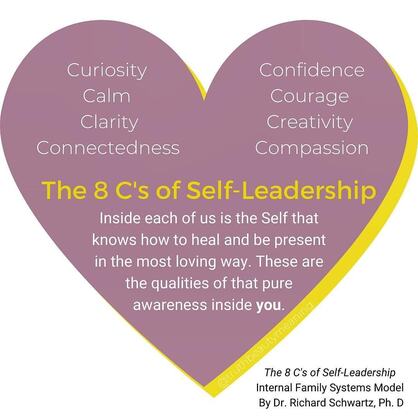
When does the cycle stop? It becomes like a snowball, gathering power and speed as it rolls through the generations. Until we say STOP! I’m going to give myself what I need. That’s a grown-up version of you. One that knows compassion, curiosity, connectedness, calmness, clarity, courage, creativity and confidence are all within them, and can connect to their inner Self. Can you recognize these qualities within you? I’m sure I could see them in you. Others will see them if you don’t. And maybe, if you go inside yourself, you will find them. I believe if you can access just one of these qualities and turn it towards your lost, forgotten parts that you will begin to experience a change within. I have experienced massive changes over the last two years that have adjusted the way I look at myself, others and the world.

This transformation has allowed me to connect deeply to myself and I am beginning to connect deeply to others. I have found, though, that I don’t get enmeshed with others like I used to. I can tell now, where I stop and they begin. I can set boundaries. A clean slate presented itself to me and now I am beginning again. This time, with a sense of knowing who I am, what my expectations and morals are and where I’m not going to give in to something that will harm me–emotionally or physically. I speak the truth to the best of my ability in the moment…I don’t sugar coat things anymore. 

I realize my humanity in all of this and recognize that I will continue to screw up and that others will too. But I’m working from all of me! All of my parts come out to play but they don’t show up unannounced—not as much, anyway. There are still remnants of little beings inside me that I need to heal, but I can recognize their efforts to be heard and I listen now. I ask curiously, can I give this part what it needs? Comfort? An ear? Reassurance? Whatever it needs, I give. Because I am now 62 and I know, deep inside, what is right for me. I have my essence—my true Self—to rely on and trust. And, with that trust comes love also; I sincerely begin to love myself. What greater gift can I give to myself and others? 

peace balance empathy
Welcoming, Loving and Trusting my Inner System

Once I was able to access my Self, my true essence (the topic of my last blog, “In Relationship with My SELF”), I was able to respond to the hurt and damaged parts of my inner system. Yes, these are the parts we often try to cut off and out. We bury them, consider them dead to us, but are they really? Only you truly know the answer to that. Mine come up in my daily communication with others and the world. They jeopardize old and new relationships alike. They definitely threaten the relationship we have with ourSelves. 

How do we recognize these parts that have manifested in response to the negative and damaging situations/experiences we endured as younger versions of ourselves? They are things like uncontrolled rage/anger, overwhelming fear/anxiety/panic, addictions, eating disorders, narcissism and the list goes on. 

These are the things, the situations, that cause us pause and, if we reflect on them, we can recognize them as parts of ourselves that maybe we don’t like very much. I challenge myself, and you, to begin to love them. They are merely extradited parts that have already been beaten and bruised, exiled and forgotten, likely never loved. Imagine younger parts of yourself that have never experienced the nurturing they needed, the love they deserved. What if we can give that to ourselves? If you have access to your true essence, that Self I talk about in my last BLOG, you can do this! I’ll even bet, you already project this kind, loving nurturance to certain individuals. What if you could do it for yourself?

I have suffered with depression (lost myself) and anxiety (feared other’s judgments) to the point that I have self-harmed and attempted suicide twice; I have suffered from suicidal ideation (the longing to commit suicide) since I was 15. Now, at the ripe old age of 62, I am finally loving myself. It is a direct correlation to my work with Internal Family Systems and when I say work, I mean it. I don’t want to portray an easy walk, but it is profoundly freeing and worth it if you are suffering.

Get to know yourSelf and your Parts. Free yourself from the restrictions placed on you in your youth. Learn to love yourself, and others, with so much understanding and compassion that you’re able to act and love in a positive relational way and be satisfied and happy doing it. Would you like to transform your life and become who you are authentically? Travel with me OR check it out on your own, but do this for you! You are worth it! You deserve it!

peace balance empathy

In Relationship With My SELF

To begin with mySelf is the only way to start. Who can I know best? Myself. I know my mind, my body and my soul. No one else knows me like I can come to know myself. And it is a journey, an exploration into all the facets of my being. It scares me, but how do I express myself if I don’t know who I am? How do I form relationships with others if I don’t know how to be in relationship with myself? 

So, I found a way to get to know mySelf. I’m using a knowledge base called IFS (Internal Family Systems). It uses a systems theory to explore the human psyche. I have learned to access the very essence of who I am, that “little fire” that now burns bright, that spark that kept me going, that wouldn’t ALLOW me to give up—not completely; that is what I have found as my essence, of who I truly am…and, everyone has this essence! How cool is that?!? 

If you’ve ever meditated, you have likely experienced this life force inside you. In IFS it is called the SELF (not a pretty label, but it recognizes who we truly are) and labelling it allows us to identify and distinguish it from other parts within us. The Self is recognised by its compassionate, calm, curious, courageous, creative and confident qualities. It is also identifiable as having clairty and an ability to connect with its own parts, other beings and the universe. It is the essence of what joins us together as a human species.

You may have experienced your Self through other forms of meditation, as mentioned previously, or in other therapies such as Wise Mind in DBT. It simply doesn’t have all the negative attachments we display towards ourselves and others. It is positive energy that flows through us, that we recognize as something greater than the messy parts within us…it may not be perfect, but it is all that is good, maybe more than we can imagine right now. Finding this essence within us is vital to our survival as human beings on this planet. Without it, the world is a very scary place. 

Spending time experiencing this life force, therefore, is extremely important if we are to find common ground among us for moving forward. Exploring all the facets that force us into communion with each other–politics, religions, relationships, love, education, play, work, illness and community–needs to come from a place of common ground so we can invite the rest of our parts in to experience the beginning of something so profound, we might not recognize it ourselves. 

As I embark on this journey, I’m sharing it because I believe it is essential to life. Risk analysis? At worst, you think I’m a crazy old lady and laugh at me; at best, you explore your Self and recognize your essence!

peace balance empathy

Giving Life to my DREAMS

I have too much and too little to say. So much that it’s difficult to organize; so little, that I question its importance. How can so much become so little? It shrinks between my brain, my fingers and the page; weeding ideas isn’t a fluid motion; it is choppy, sloppy and sometimes, fruitless–as it has been for me these last few days. Making a mess of it, seems like a likely result, but I’m human–making a mess and fixing it is what I do.

I want to write. I want to share ideas. The goal is not to impose but to question. It is not to judge but to explore curiously–everything. What am I exploring? Well, life, and all of its facets. Relationships, love, politics, religions, education, play, work, illness and community. I’ve likely forgotten something, but it’ll come out as I think and write.

Exploring curiously means questioning the many facets of each of the items above. Asking questions, researching ideas and exploring the sentiments and meaning of each. Do we need all these things in our lives? What do they look like today? What do we want them to look like? How do we want to approach each of them? Many of these topics represent things we don’t really want to look at. They are off-limits. We don’t talk freely about politics or religion, especially, as they are considered to be topics of deep emotional connection–we have trouble listening to opposite opinions on them because we are so indoctrinated by our own beliefs. My experience, anyway. 

So, how do I, as a thinker and a writer, involve others in a communal discussion around the necessities that life as a human being imposes on us? Where do I even begin? I’m going to go deep within myself; I’m going to dig into my own psyche and actually share parts of it with you. It is the only thing that I know, for sure, exists because it comes from within me; it comes from who I am. IF I can maintain this passion, and I really hope I can, we are embarking on, not only a journey of self-discovery, but also dipping our minds into discoveries around topics of interconnectedness.

My theory? Focusing on ourselves allows us to live together in a harmonious way. It’s a dialectic phenomenon. Focus on ourselves in order to become closer to others. So…I’m trying it. I’ve been focusing on ME for a couple of years now and I will continue to approach life this way, but NOW, I want to bring everything together by inviting others on a journey of reconciliation with themselves and others. If we can’t accept our own shortcomings and human evolution, how can we accept the humanity of others? I dream of a human experience with myself and others because that is what I am capable of–as a human. What do you dream of?

In the days ahead, I’m going to allow my creative voices to come alive! You, too, have value and an insightful intelligence inside you. If you are one of the ones who wants to use it? I am here to listen! I’m going on this journey. You may join, if you like…

peace balance empathy