Building Boundaries

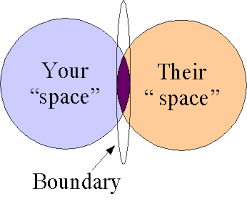
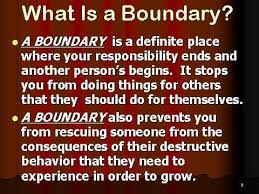
There are three ways to define boundaries. They are permeable, rigid and healthy. A permeable boundary is one that is easy to cross; there is very little substance to it. A rigid boundary is the exact opposite as it is like a brick wall that nothing can get through. Healthy boundaries, however, reflect what is important to us; it is a way to set limits in relationships dependent on our values and our need to stay safe. In my own life, I have waffled between loose (permeable) and rigid (brick wall) boundaries, often choosing the wrong type for the situation I find myself in. I am striving to change this.

When using permeable boundaries, one can become overly enmeshed with other people. Personally, I can get drawn into situations that are emotionally unsafe for me. My line is crossed because I didn’t protect it and I usually feel anxious or even angry and resentful. It is not the other person’s fault, it is mine. People need to be shown boundaries in order to respect them. If they don’t want to or don’t seem to understand, it must be made very clear, hopefully assertively. If they still refuse, maybe it is time to back off of that relationship or leave it completely depending on your values and ability to continuously assert yourself.

When using rigid (brick wall) boundaries, one can be closed off from other people. Relationships do not exist. It is a very lonely place but sometimes it feels better than having to set healthy boundaries. When I really struggled with assertiveness, I kept rigid boundaries. I didn’t know how else to stop people from getting in my space so I made sure no one got in. When envisioning a safe space, I was on an ocean beach with three high walls where the ocean wasn’t. I would tuck myself into a back corner; sometimes my inner child was with me (but I will save that story for a different day).

I have learned, over the past years, that healthy boundaries are mostly based on our values; what are those characteristics that we hold close to our hearts? By completing a few exercises in a workbook I found online, I came up with the following values for myself: to be valued, to feel worthy, to have and give respect, to be accountable, to be reflective, to make connections with others, to have the courage to share my stories, to show compassion and to use the thought/behaviour/feeling triangle as a basis for challenging difficult crises. I then made up my own “mission statement”.

I will cultivate value, worth, respect, accountability and reflection into my life and apply it by integrating courage, compassion and connection into my thoughts, feelings and behaviour towards myself and others.

It’s a bit of a mouthful, but it is clear to me and I think I can use it, embody it into my daily life to become a healthier, more productive, ‘me’. My healthy boundaries, then, protect this mantra. I’m going to include the link to the boundary workbook that I walked myself through as well as share a couple of pages that might help others set healthy boundaries also.

Here is the link to the workbook:

And here are the two pages that helped me to actually write down some boundaries and might be helpful for you to set your own boundaries if you also struggle in this area:
Living Love

What does it really mean to love? How do we practice love towards others? How do we practice love towards ourselves? Can we love others without loving ourselves? The word love here is used as a verb. It is an action and, I believe, it can be professed as true love only as much as our actions support it. That is, we have to behave in love in order to actually profess our love. I think sometimes, the words, “I love you” are used too loosely. The actions that would support love–accepting someone as they are, unconditionally–are often lost within this extremely important affirmation. Love is not conditional on someone changing. If someone needs to change to be loved, they are merely ‘fitting in’. If we need to change in order to feel worthy of love from others, it is not true love. To really love someone is to accept them as they are, with all their faults and shortcomings, with all their ups and downs and, especially, with all their shame and vulnerability.

I looked for images of “Love” to include here and almost all of them say, “Love is Blind”. What does that even mean? To love blindly would be like never seeing the person you are loving for who they are, wouldn’t it? I don’t think love should be blind to a person’s shortcomings; I think it should be open to their faults and vulnerabilities and to love them regardless. That is how we practice love! Through acceptance. For someone to be worthy of love, they shouldn’t have to change. If they need to change, it is not true love. Having said that, it does not mean that those we love don’t need to be accountable for their own actions, thoughts and feelings, they do! Just as we need to be accountable for ours.

In my mind, the love we hold for ourselves has to be the same as the love we hold for others or it is not true love. We don’t really love ourselves if we feel we have to change in order to be accepted by others. That is just conforming to others or trying to fit in. It is not self love. In order to truly love ourselves, we need to acknowledge who we are with all our idiosyncrasies and step out into the world bravely, imperfectly! Yes, we will change as we grow but we don’t need to change to love ourselves or to be loved by others. We must, I believe, embrace our shortcomings, accept them, if we are to truly love ourselves. Can we do that? Is self love achievable? I think it is; although, I wouldn’t say I’m quite in the flow of it yet. This kind of love takes tremendous courage, I believe more bravery than it takes to love someone else. We are more critical of ourselves than we are of others! Practicing self love takes heroism to a new and critical level. 

I was looking, again, at quotes for self love and I found many that consider “self love” as a prerequisite for loving others. I’m not sure I believe this; although, I could likely come up with arguments for both. Now, as I sit here contemplating this statement, I find myself questioning my own beliefs. I was of the mind that loving others wholeheartedly could be done without loving ourselves in the same way. I think of myself as an aunt and how much I love my nephews–especially when they were little–but how much I would chastise myself during that time. I was never good enough, brave enough or smart enough for myself, but I loved those boys as if they were my own and with every part of my soul. Now, as an afterthought, I have to wonder if I didn’t force some of my own degree of self-hate on them. I remember when they were twelve, I made up a binder of exercises they could do to build themselves up for hockey (they were both pretty good little hockey players). I think back now and wonder was it all too much at once? Did I overwhelm them with my enthusiasm for their little lives? It’s something I would have done for myself and expected myself to work through the entire binder in a week! If I had loved myself back then, would I have introduced them to a smaller, gentler approach? We will never know and I’m not going to beat myself up for it as I was only doing what I felt was right at the time. If one of them comes to me and blames me for their own lack of self-worth, I will honour their feelings but they are old enough to take responsibility for their own decisions now. I think we do the best we can for those we love unconditionally. While we’re always in a growth spurt ourselves, I guess we will make mistakes in the name of love. But we can’t allow those mistakes to control who we are now. We will always need to make amends as we are imperfect. I’ve gone off on a completely different tangent here and I apologize for dragging you all along. 

So, I guess, the question is still up in the air, can we love others without loving ourselves? Yes, I’m asking!! What do you think? What are your stories? Thanks, Jaidan

peace balance empathy

3 Big “C’s” and a “B”

In her book, “The Gifts of Imperfection”, Brene Brown identifies these gifts as compassion, courage and connection. My understanding of these three gifts are that compassion includes both caring for others and for ourselves. Courage is identified as showing up with all your insecurities and being willing to make connections with others. Connection needs to be highlighted by the ability to take risks with each other, holding ourselves and others accountable for the actions and behaviours we display. 

What compassion means to me is treating others with respect and being non-judgmental. The same holds true for the way we treat ourselves. We owe each other and ourselves the respect of truth and honesty while being non-judgmental in our encounters with each other. To me, this means accepting ourselves and others, our feelings, thoughts and behaviours while also expecting accountability for the role we play with our actions. In this way, compassion does not become a free for all acceptance of everything we do, but a boundary driven force with the intention to take responsibility for our own healing.

To me, courage is the ability to stand up in front of others with our shortcomings, failures and shame, feeling the vulnerability but pushing forward with communication regardless. It also, I think,  means accepting responsibility for our own journey through this life and changing accordingly. It is a strong person who reveals his/her own fears and shame with others. I do believe that this must be done in a safe way, with someone whom we trust, who has themselves shown vulnerability and with whom we feel comfortable with. This leads straight into connection.

I believe that we have different levels of connection. There is a surface level association with others that does not require us to give of ourselves completely. The casual relationship with no strings nor trust per say. There is a general friend that we might enjoy the company of and who may one day come into our inner circle but neither of us have taken any risks with our feelings yet. Finally, there are a few (and maybe only one) inner circle mentors with whom we have taken risks (showing courage) and shared our stories (or at least a bit of our story). This has coincided with an acceptance of each other (compassion) and the ability to hold each other accountable (being honest without judgment). Each level of connection has boundaries that we set for ourselves and for others in order to keep ourselves safe. This does not mean that we are not taking risks–setting boundaries is a risk and takes courage.

The one thing that is not overly clear to me in all of this is the setting of boundaries. I tend to have an all or nothing reaction to boundaries. I divulge everything or nothing, often with the wrong people. This, then, becomes the work I need to do. I need to find out more about boundaries and how they are used to keep me safe. I need to explore how to set appropriate boundaries. What do they look like, feel like and sound like? Boundaries! The work I need to do as I move forward. This, by the way, is taking responsibility for my own journey of healing which I am approaching very seriously. I have my work cut out for me. I think I know where I’m headed and that I’m on the right track. Have a great day! Jaidan

peace balance empathy

Digging Deep

Yesterday I made up a timeline of all the major events in my life. I wanted a clear picture of where I’d been, of what had contributed to the way I am today. I tried to include everything both traumatic and otherwise. My hope was, and still is, that I’d be able to put to rest some of the negative influences in my life. The circumstances that have led to most of my struggles with mental illness. I find sometimes it is difficult to tell the difference between nature and nurture. What seeds were planted before I was even born? And what are the weeds that I need to tend to? I think I’ve come to the conclusion that the two (nature and nurture) go hand in hand. It is difficult to look at one without considering the other. My natural tendency of sensitivity has been molded by experience. And the events in my life have been secured by my sensitivity.

In most of my previous blogs, I have focused a lot of attention on the relationship between thoughts, behaviour and feelings. The incredible fact is that you can change one of those concepts and it will result in the other two changing as well. This is a great solution to many immediate psychological struggles and it works! It takes a lot of time and energy but it can help one change feelings about the self and about the world. This can be monumental to recovery. I think, personally, it can get you to a place where you can then dig deeper. Despite the amount of effort that goes into achieving results, I think it merely helps you to continue the journey into psychotherapy.

Some therapists, psychologists and psychiatrists believe that changing thoughts is the most important step in a psychological journey and they will even discourage the deep dive into psychotherapy, saying it can be traumatic in its own sense, that it is a needless trip down memory lane that will only thwart one’s ability to maintain a healthy lifestyle. I don’t believe this.

One of the steps to overcoming negative feelings is to sit with them, to allow them to come and to really experience them. This is taught in Dialectical Behaviour Therapy (DBT) which I have talked about a lot in previous blogs. Pushing feelings away or burying them does not work! It only makes them more powerful. We are taught to think about our feelings curiously and to ask questions of them. If we are to ask questions then, I believe, we must also search for answers. Psychotherapy allows us this freedom. Now, I’m not saying that everyone needs psychotherapy. I think you can explore your feelings on your own or with the help of a self-help workbook, but I really think that digging deep has to be a part of the recovery process. I am at this point right now. This doesn’t mean I ignore everything I’ve learned from CBT and DBT. I still need this type of therapy to stay balanced. It just means that I think I’m ready to really dive into my life and explore the negative and positive effects of how my experiences have affected my life and me, as a person. 

At this point, I would like to strongly urge you to accept help on this journey, especially if you have had trauma in your life. Remember that I am no expert, but there are experts out there! Acknowledging your feelings and experiences can lead to re-traumatization so be careful if you choose to follow this path. I will be working with a therapist while exploring this part of my journey. I feel it is the safest way for me. I will also be reading some of Brrene Brown’s work, in particular, “The Gifts of Imperfection” and “Rising Strong”. I have a workbook for The Gifts. I bought it on Amazon. I am hoping I am well-prepared for the journey ahead. Take care, Jaidan.

Peace balance empathy

Worried Sick

I am so sick of the worry in my life. It runs rampant in my mind and there seems no end to where it can take me. It’s as if it is infiltrating my entire being. My whole body feels it’s presence. And for what? Absolutely nothing! When I push to check it out, there is no basis for my fear. Why is it even there? I have to find a way to let it go. I guess, if I practice what I preach, I need to first accept it. Sit with it. To sit with it and think curiously, I wonder where it comes from? Trying to be non-judgmental is incredibly difficult. I want to chastise it, beat it up, yell at myself about it. I feel the need to stuff it under something so it can never come out. I internalize and beat myself up for having this incredibly mind consuming angst. But I will try to sit with it and curiously explore its painful existence.

Why are you here? How did you come about? Where do I hold you in my body? What is your purpose? When did you pop up in my life? Not easy questions to answer and maybe I can’t delve into these without some help from a resource or my therapist who might be able to guide my exploration. I think I will do some research to help me navigate this analysis. The first step I will take will be to work through the worry resource from the CCI resources–they can be found in the menu at the top of my blog for those of you who also struggle with worry. 

For now, I am going to set my worries aside. I am going to do what I can to accept them as a part of my life right now. I’m not going to ignore their existence, I am merely postponing the exploration until another time when I can concentrate and really give them my undivided attention. Hopefully later this afternoon around 1:00 pm. There, I’ve set a worry time! I need to be disciplined enough to make sure I really do it because I’m pretty sick of how it is taking over my life. If you’re finding worry to be taking up space in your mind, maybe it’s time to really explore and navigate around it, non-judgmentally.

Here is the link to the worry resource from CCI:

https://www.cci.health.wa.gov.au/Resources/Looking-After-Yourself/Worry-and-Rumination

peace balance empathy

Let’s Get Happy!

Hmmm…doesn’t that just bring a smile to your face? Or, are you thinking, get me out of here? Or is it, whatever, heard this song and dance before? How about shame? Anyone feel shame? I lived with it for years. It’s difficult to live with a mental illness and not have to deal with shame. One of the most difficult times in my life has been dealing with the shame of feeling happy. What right do I have to feel happy?

I have been off work because of my struggles with depression and anxiety and one of the hardest things to allow myself to feel was Happiness. How could I be happy AND be on disability? The two just didn’t sit well with me and thus the shame came when I actually felt good. I worked through a lot of distorted thoughts using CBT to get me where I am today. That is in a place of satisfaction and yes, even happiness. I still experience shame in this situation, but it isn’t near as heavy as it used to be.

A friend once told me that “The pursuit of happiness is a child’s dream” and it made me question my own happiness. Was I fooling myself? It sure didn’t feel like it. I was actually enjoying being alive–for the first time in ten years! It took a lot of hard work in therapy to get me there, but I had managed to arrive! And it wasn’t really an arrival but a process that is still on-going. I don’t thing happiness is stagnant and it is not a point of arrival, but a place that shimmers and shakes. There are good days and bad days for everyone; we all suffer with the “pursuit of happiness” during our lifetime and I am no exception. But at least I can now actually reach that ideal and finally accept it.

I think happiness is different for everyone and also that it moves along a continuum. For me that continuum begins with contentment and ends with euphoria. In between there are levels of delight, enjoyment, exuberance and exhilaration. I think my happy medium is somewhere between exuberance and exhilaration. Sure, I don’t stay that high all the time; there is a general sway to my happiness at any one time and it can change in a flash. I think that happiness is a difficult emotion to sustain for any length of time, but I do think it’s attainable. It might be a different continuum for each individual. Your perception of happiness could be very different from mine but that does not mean we can not reach our own level of joy.

How do we get there? Everyone’s journey will be different but I think that it is important to be able to accept all our emotions. To be able to sit with them and let them go. I have talked about this phenomenon many times in previous blogs and it sits well here. In order to have happiness, we need to accept all feelings, without judgment or ridicule and to move on from this point of approval into a medley of feel good sensations. From there we can begin to experience happiness of many levels and degrees. What is your happy? Where does it come from? Where does it begin? Find your level of happy and learn to accept and appreciate it. You’ve got this!

peace balance empathy

FEAR

I’m debating on what I will talk about today. Even as I write this, I haven’t decided how it is going to turn out or what I am going to say. I guess I will begin with my truth. I am very disturbed by the way our world and our country, in particular, is dealing with Covid. And maybe I’m most disturbed by my own inability to set my truth straight. Quite honestly, I don’t know yet where I stand and I feel some shame about that. Whereas others seem to be certain and confident about what they believe, I am still sitting on the fence. I’m not willing to commit to one view or the other. I hate that we’ve been divided into US and THEM! Maybe I will just take a moment to explain something I am quite sure about as I stand on the outside looking in. I believe everyone’s truth is controlled by fear! There seems to be only two ways of looking at how Covid has impacted our world. Either people are afraid of getting Covid and dying or they are afraid of our government’s tyranny and the vaccine. I don’t seem to be afraid of either.

Some days I find myself questioning the government’s decisions–both federal and provincial–and other days I question whether or not I am safe walking around without a mask on. Once again, in my life, I find myself caught in a dichotomy between truth and lies and fiction and reality. I have to catch myself there and go back to fear as that is what is driving both of these views. Is there any substance to either of them? Do we really need to be afraid of either one or the other? Or is there some happy medium right down the centre that can explain each. Do we need to be afraid of each other, I wonder? Are both extremes dangerous? Ah, now that hit a real nerve.

Is that where I stand? Am I driven by the fear of either ultimatum? Have we always lived in fear of something? Is that just what drives us in general? Is that why anxiety is so rampant in our society and in my life, in particular? I’m sitting here trying to think of what life was like before Covid. It’s not an easy thing to conjure up and that really scares me. I have to take a moment and really think here. Took some time to ponder and I believe maybe death motivated us before Covid. Then, of course, we were slapped in the face with death! I remember Italy was hit pretty hard with Covid when the scare first came out because of their aging population. I think their numbers put the fear of God into us. I wonder, now, if that fear wasn’t embellished somewhat at the time.

I don’t have clear answers to any of my questions about either the fear of Covid or the fear of our government’s tyranny and vaccines. Thus, I sit on the fence. I hope, for the sake of mankind, that both fears have been exaggerated and that we can begin to live our lives again. I do, however, fear the division in our society. I think that is a very real fact that fuels my own anxieties at the moment. It’s been good for me to work that out here. Thank you for giving me the opportunity to explore my own fear.

Peace, Balance, Empathy!

Perfectly Imperfect

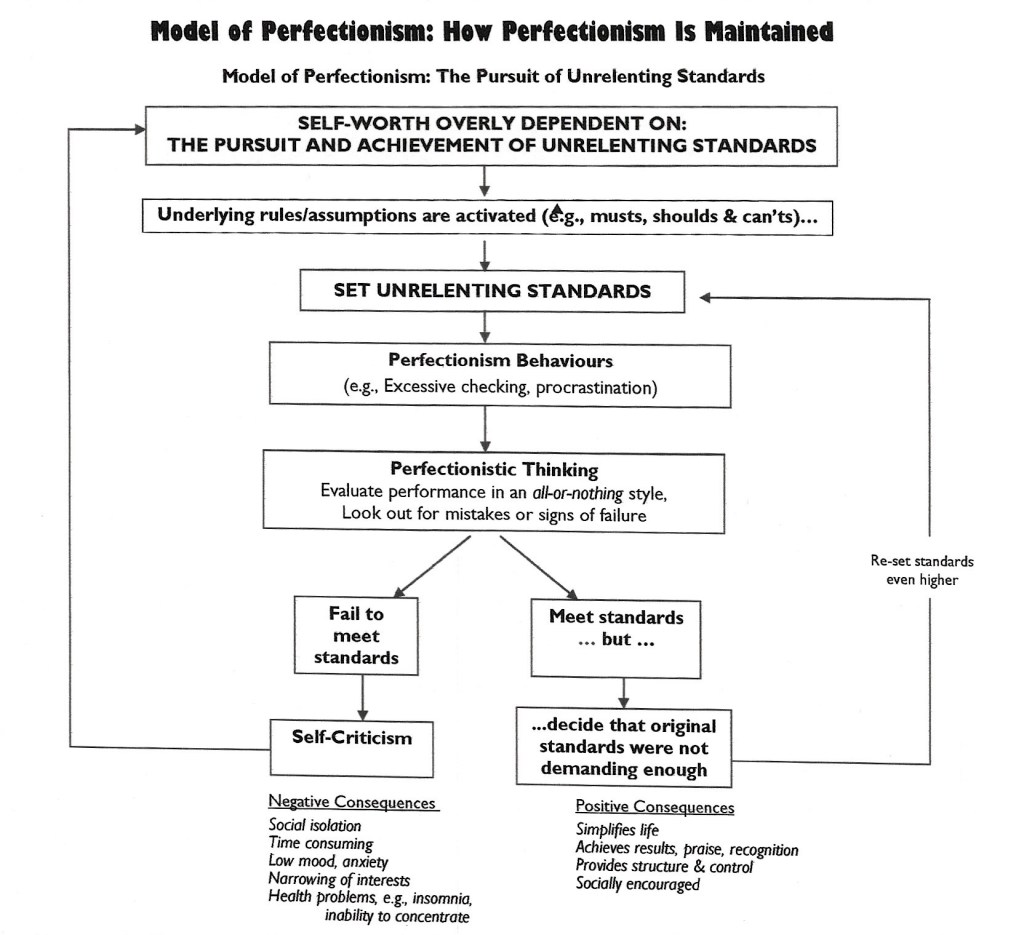
I honestly forget where I heard or found “Perfectly Imperfect” but it has stuck with me over the years. I am constantly reminding myself that perfection doesn’t exist. High Standards, however, are perfectly okay! The problem comes when those ideals actually interfere with our quality of life in a negative way. Some examples from my life would be: not finishing a test in time because I pondered every question and answer until time ran out, procrastinating about doing something until the last minute because I am afraid of not doing it well enough, chastising myself for making a mistake, trying to learn about everything so I don’t feel stupid in any conversations, difficulty making decisions because I am afraid I will make the wrong one, winning awards and brushing them off as no big deal, etc.. I could likely fill a page with the trouble imperfection has given me over the years. It comes down to I AM a failure instead of I made a mistake or I failed. You might find I repeat myself from my last post on Failure as we tangle with imperfection. That is okay. If I say it more than once, it is likely very important.

As you can see from the diagram above (taken from a CCI resource), Perfectionism is a never-ending cycle of thoughts and behaviours that support our pursuit of unrelenting standards! You will notice, also, that there are positive outcomes for setting high standards for ourselves. We DO do things to the best of our ability as long as we don’t give up or run out of time. Calming a perfectionistic mind into imperfection and acceptance of that imperfection is the key to overcoming this incessant, mind-boggling cycle. But how do we do that?

Well, I just witnessed first hand what imperfection can do. I had two more sections written here and deleted them when I switched to my phone to double check for errors! My first thought? How ^*#*^%$# stupid of me! Oh No! What am I going to do now???? It was a great piece of writing, I thought, not perfect, but good! I don’t think I can do it again!! And I waited in silence for a minute, just hoping beyond hope that it would return; that somehow I could get it back because I was sure I couldn’t do it again! But here I go…

…and we push on…that’s how we face defeat. There is a link here between thoughts, behaviours and feelings so if we change one, we can change the other two. I believe that changing my thoughts takes precedence here because they are what really drive perfectionism. I’m reminded here of the saying, ” to have what you’ve never had, you need to do what you’ve never done”. Or in this case, “think”. And right now I’m thinking this is nowhere near as good as my original ‘thoughts’. I’m going to change that thought, right now, into, “this is better than my original work because I am actually dealing with thoughts of imperfection”! I have to try and believe that is true. Now, you should know that I have done laundry and gone for a walk to “clear my head” and to distract myself from all the negative thoughts about my “mistake”. And you’ve likely forgotten what that was! In case you can’t read the definition of ‘Flawsome” above, it says, “an individual who embraces their “flaws” and knows they are awesome regardless”. I am flawsome because I have continued to write; I am taking a risk–again.

There is a good side to imperfection if we can embrace our trials. There is freedom in knowing that mistakes are actually a good thing; that they help us learn and grow. Imagine celebrating our blunders, giving them credit for changing our thoughts and behaviours in the future. Imagine living life with abandon. I’m sure you’ve thought about it. I know I have. What if we actually put this into practice? What if we take our faults and turn them into excellence? Maybe I’ve done that today because I often find that when my written work seems poor, it actually reaches more people! What a dichotomy that is! So, embrace what you think are your short-comings; revel in your inadequacies; put faith into your faults! Begin to exist within your errs and emerge as who you truly are! Get really good at being you!

If you want to delve further into perfectionism, you can follow this link to a workbook put out by CCI. It contains exercises and information that will help you on your journey to becoming who you really are:

https://www.cci.health.wa.gov.au/Resources/Looking-After-Yourself/Perfectionism

Meeting with Failure

“Failure is at the beginning of all success; it’s how we learn and grow”, I used to tell my students, “Don’t be afraid of failure; be afraid of not trying“, I would say. But how did I honestly perceive my own failure? What did I still need to learn? It’s easy to read these quotes and even believe them, but do we actually practice at failure? Just imagine, setting out a plan and following it, knowing you’re going to fail at some part of it? Maybe all of it, but at some point there has to be failure or there is no growth. And I believe we are always learning and growing. I don’t think we come to a complete understanding of anything until we have failed–often more than once–at what we are trying to achieve. This will be a difficult concept to grasp especially if we are perfectionists because a perfectionist doesn’t have the capacity to accept failure. I place myself in this group as I have always shuddered at my own failure. To fail was a reflection of me as a person, on my being. My perception of reality did not include failure. It’s like the shame vs. guilt argument. Instead of thinking, “I failed, now what can I learn from that; how can I make it right?”, I think, ” I am a failure; it is part of who I am, not what I do.” When, in fact, the exact opposite is true.

Failure is still very difficult to accept, but so is success. What a conundrum I live in. I have mentioned in other blogs about my two breakdowns shortly after receiving awards at work–at two different jobs. My self esteem was so low that accepting any kind of encouragement or reward was just way out of my comfort zone. I couldn’t handle it. I failed at success! I mean I was doomed no matter what I did. Failure was imperfection and success was beyond me. Never did I dream that I needed to become a successful imperfectionist. How did the two even relate to each other? It was a dichotomy, just a senseless riddle and it had no place in my vocabulary. I was meant to learn and really understand how failure is a part of any successful life. But it was hard; I’m still not sure I’m there yet. I want to be, but am I? Maybe the answer to that doesn’t really matter; maybe just being aware of the continuum between the two is enough, for now.

Sometimes when I look back on my life, all I see is failure. My mind just doesn’t register successes. I have to turn a switch somewhere. I have to reorganize my thoughts to accept both these concepts as facts of life because that is what they are! I wouldn’t be lying to myself; in fact, rejecting them is lying to myself. I am telling myself lies! But what do I tell others about this? I tell them success doesn’t come without failure. Why can’t I tell myself the same thing? I have to or I am lying to others. That’s how I work it out. That’s how I come to accept it as truth in my life because it is truth in everyone’s life. I am not special in this regard. I can no longer believe the lies I am telling myself about failure and I have to accept that I can also succeed, have succeeded. I am succeeding now! And so are you. If you have trouble with failure and success, maybe you can also break free by changing the lies you are telling yourself into truths. Give it a go! Take a chance! You, too, can succeed at failure!